📅 Published: Aug 3, 2026 | 🔄 Last Update: Aug 3, 2026 | ⏱️ Read Time: 8 min read
TL;DR
Most living rooms get the rug wrong by buying for the bare floor instead of the furniture. The Rug Size Rule fixes this: the rug should be large enough to connect the sofa, chairs and coffee table into one zone, with at least the front legs of every main seat resting on it.
A small rug tucked under only the coffee table makes even an expensive room look cheap and disconnected. Start from the seating layout, leave a border of about 20 to 45 cm of exposed floor, and run a quick floor test with tape before buying. Pick the material for how the room is really used, and always use a rug pad on hard floors.
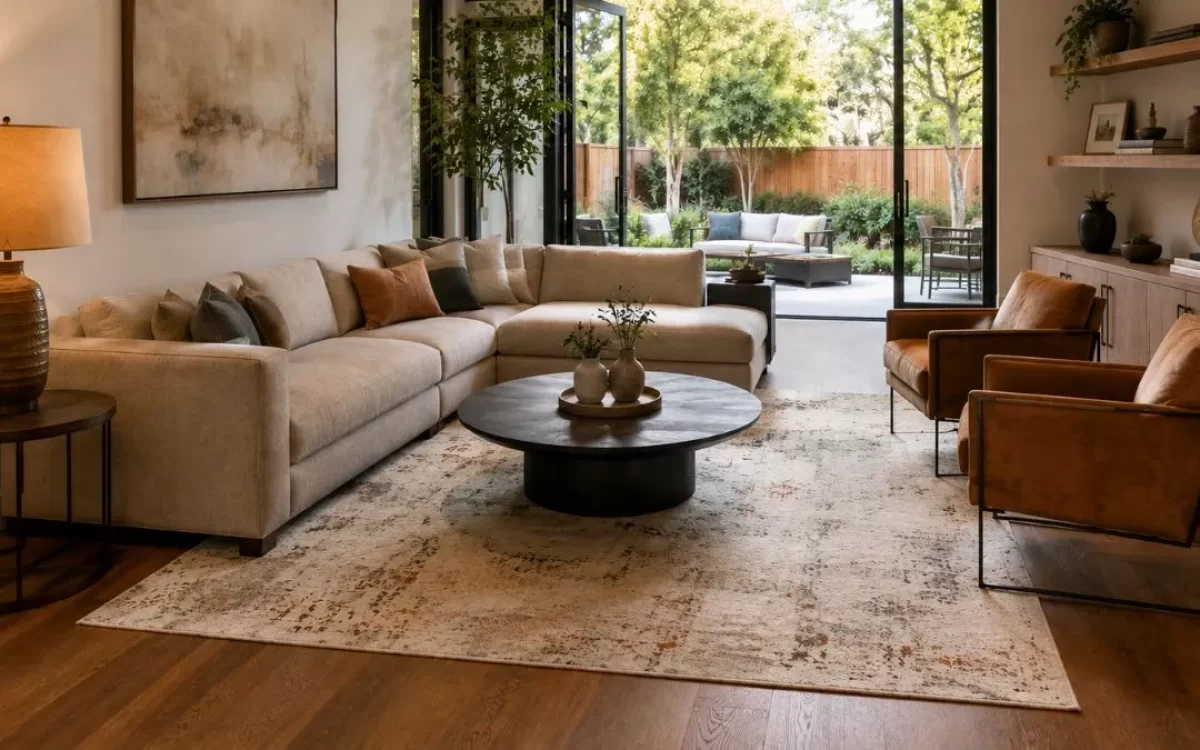
A beautiful living room can still feel unfinished when the rug is too small. This is one of the most common mistakes in otherwise well-designed homes. The sofa is generous, the coffee table is sculptural, the flooring is expensive, yet the rug sits under the table like a small island. Instead of pulling the space together, it breaks the room into pieces.
The rug size rule living room owners most often get wrong is simple: buy the rug for the furniture grouping, not for the bare floor you happen to see in the room. A rug is not a decorative mat dropped in the middle of the space. It is the base that gives a seating area its scale, warmth and sense of intention.
This guide covers the correct dimensions, the right shape, practical placement, material choices and the small styling details that make a living room look considered rather than crowded. If you are furnishing an apartment in Mumbai, a villa in Gurgaon or a new home in Bengaluru, these ideas will help you choose with confidence.
What Is the Rug Size Rule?
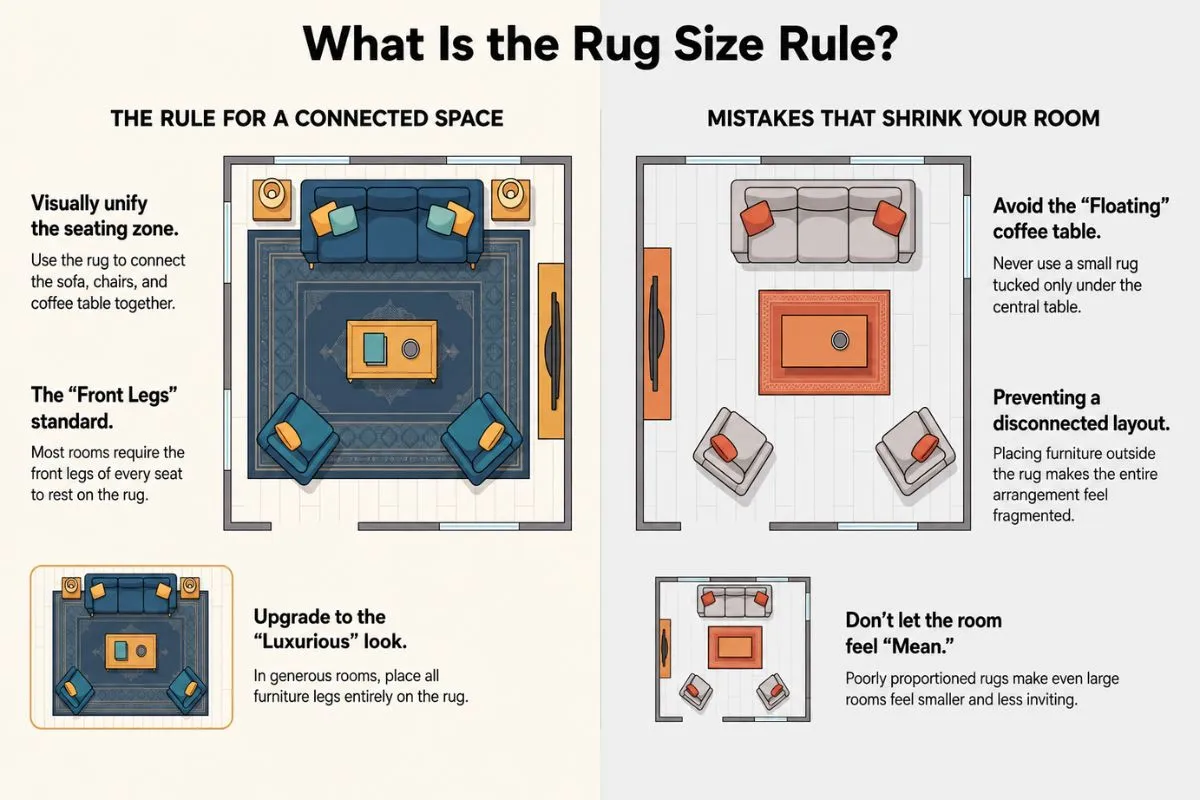
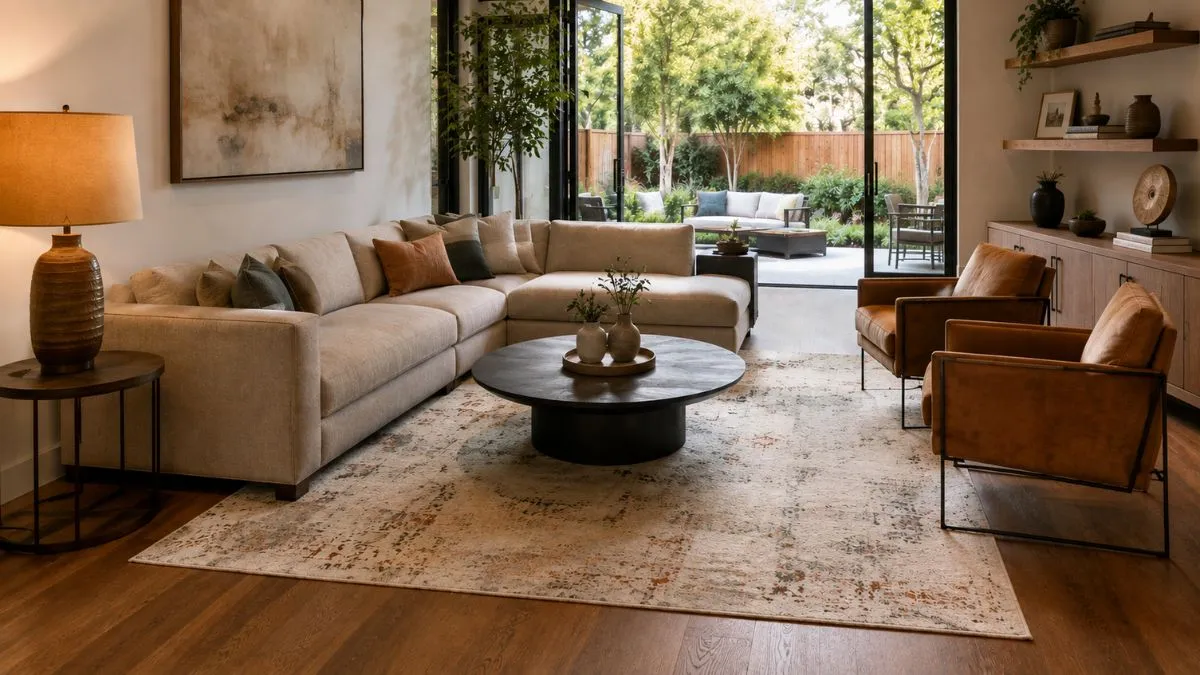
The rug size rule is straightforward. The rug should be large enough to visually connect the sofa, chairs and coffee table into one seating zone. In most living rooms, that means the front legs of every main seat should rest on the rug. If the room is generous, placing all furniture legs on the rug looks even more luxurious.
What should almost never happen is a small rug tucked only under the coffee table while every sofa and chair sits outside it. That arrangement looks disconnected, and a well-proportioned room starts to feel meaner than it really is.
The Practical Formula
Start with the seating arrangement, not the wall-to-wall room size. Aim to leave a clear border of exposed flooring around the rug. In a typical Indian living room, a border of about 20 to 45 cm usually feels balanced. Very large rooms can carry a wider border.
The One-Minute Floor Test
Use masking tape, newspaper sheets or an old bedsheet to mark the proposed rug size on the floor. Then stand at the room entrance and look. If the marked shape only frames the coffee table, it is too small. If the sofa and chairs feel anchored inside one shape, you are close to the right size.
What Size Rug Does Your Living Room Need?
| Living room arrangement | Recommended rug size | Placement rule | Why it works |
| Compact room with a 2- or 3-seater sofa | 5 x 8 ft or 6 x 9 ft | Coffee table and sofa front legs on the rug | Creates a neat zone without covering too much floor |
| Standard living room with sofa and two accent chairs | 6 x 9 ft or 8 x 10 ft | Front legs of sofa and both chairs on the rug | Makes the seating group feel connected |
| Large family room with L-shaped sectional | 8 x 10 ft or 9 x 12 ft | At least the sectional’s front legs on the rug | Gives a large sofa visual weight and control |
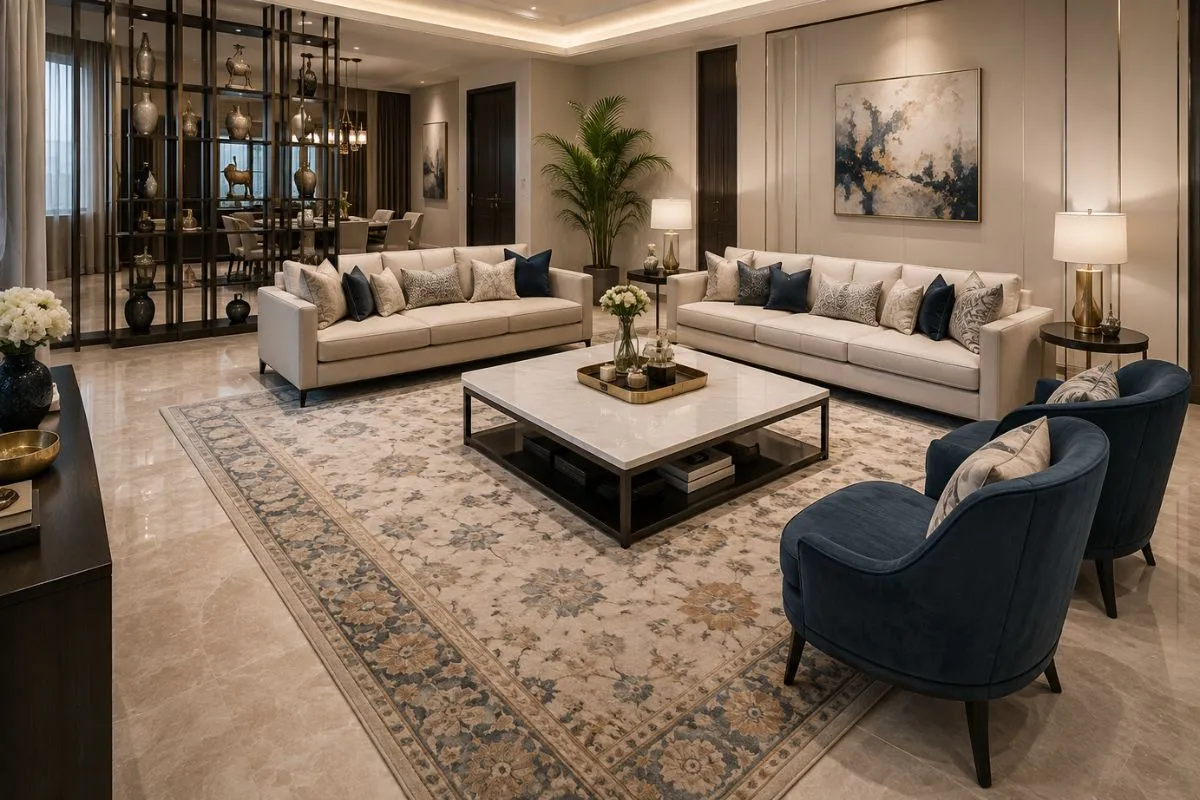
| Formal living room with two sofas facing each other | 9 x 12 ft or custom | Ideally all sofa legs on the rug | Produces a refined, hotel-like arrangement |
| Open-plan living and dining space | 8 x 10 ft, 9 x 12 ft or custom | Keep the living rug fully within its own zone | Separates functions without adding walls |
Layouts That Need Extra Care
Two situations catch people out. A floating layout, where the furniture sits well away in the middle of the room, needs a rug large enough to hold the whole grouping on one shape; this is exactly the spot where an undersized rug looks obvious. Two sofas facing each other also demand a generous rug, ideally with all front legs resting on it, so the pair reads as one composed zone.
What About Rug Shape?
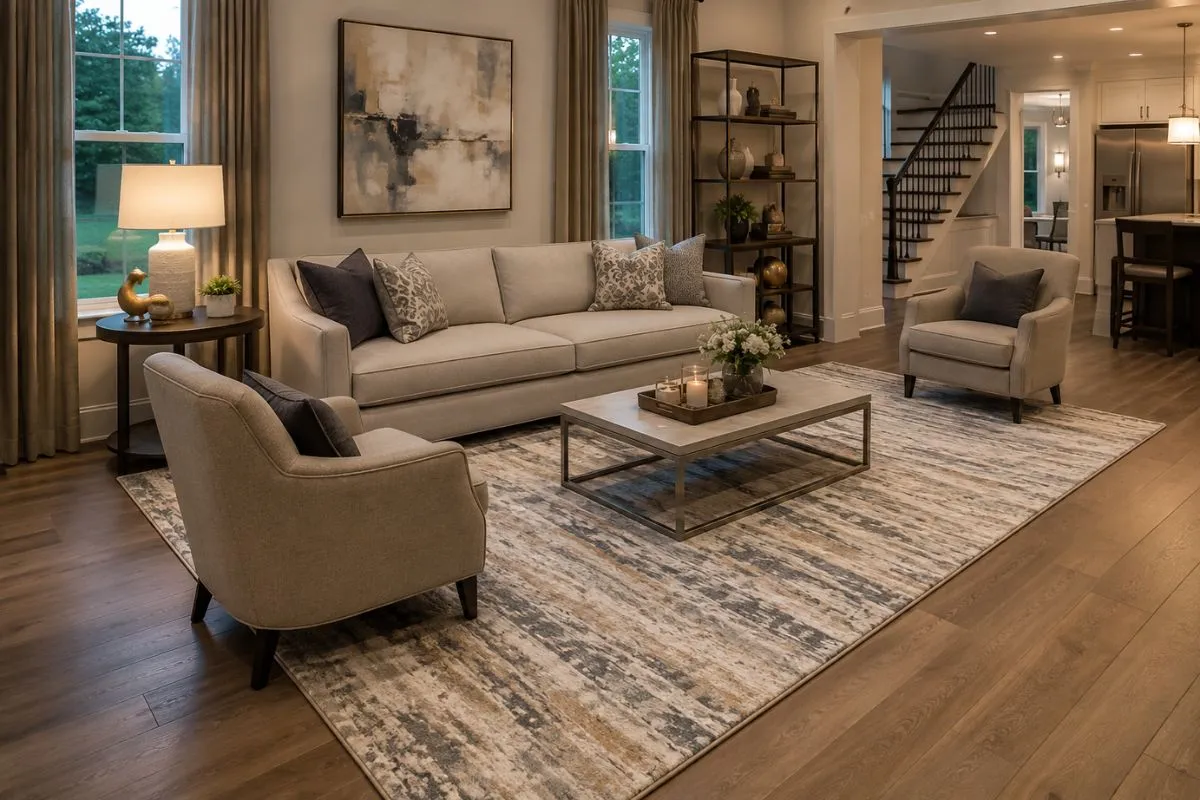
Most living rooms suit a rectangular rug, because sofas, sectionals and coffee tables are built on straight lines. A rectangle mirrors that geometry and frames the seating cleanly. Even so, shape is worth a moment of thought before you order.
- Rectangular: the safe default for almost every sofa-and-chairs setting. Match the long side to the length of the main sofa run.
- Round: suits a compact seating nook, a round coffee table, or a corner built around curved or single-seat furniture. It softens a boxy room and works well in a reading corner.
- Runner: useful beside a long sofa in a narrow room, or to link a living zone to a passage in an open-plan flat. Treat it as a support piece, not the main anchor.
No matter the shape, the sizing rule holds. The rug must still reach under the front legs of the main seats and read as one connected zone.
Sofa Legs: On the Rug or Off?
For a polished result, the front legs should sit on the rug. This suits most homes because it balances generous layering with visible flooring.
Here are the three placement options, arranged safest to most luxurious.
- Front legs on the rug. Best for most homes. It creates connection without demanding a huge rug.
- All legs on the rug. Best for expansive rooms and custom luxury rugs. It reads calm, deliberate and generous, and works beautifully when the rug itself is the hero of the room.
- All legs off the rug. Use this only in a very compact room where a larger rug would block doors or circulation. Even then, the rug must extend clearly beyond the coffee table on every side, or the look turns accidental.
Why a Small Rug Makes an Expensive Room Look Cheaper
Luxury is largely a matter of proportion. A small rug leaves large pieces of furniture visually unsupported. The sofa seems to float, side chairs look pushed aside, and the coffee table becomes the only object with a base. The room may hold premium finishes, yet it will not feel composed.
A correctly scaled rug also softens the acoustics. Stone, glass and polished surfaces can make a room sound sharp or echoey. Wool and other dense textile rugs absorb some reflected sound, which makes conversation more comfortable. This matters most in high-rise homes with open living-dining layouts.
If your home has imported or Italian marble, the rug deserves extra thought. This marble is commonly supplied in a 20 mm thickness and a pre-polished finish, giving it a clean, reflective surface that can feel visually cool. A substantial wool, silk-blend or hand-knotted rug adds softness without hiding the marble’s character. Use a quality rug pad so the rug stays secure and does not abrade the stone as people move around.
Which Rug Material Is Right for You?
Material affects far more than looks. It decides how the rug feels underfoot, how it handles dust and humidity, and how well it suits a formal or a busy family space. The best luxury rugs are not always the most delicate ones. The right choice is the one that matches how the room is actually used.
Rug Materials Compared for Indian Homes
| Material | Best suited for | Strengths | Watch-outs | Care level |
| Wool | Main living rooms and family lounges | Soft, durable, naturally resilient, good sound absorption | Sheds lightly when new; needs professional cleaning for major spills | Medium |
| Silk or silk blend | Formal, low-traffic spaces | Fine sheen, detailed pattern, premium feel | Sensitive to stains, moisture and rough footwear | High |
| Jute | Relaxed, earthy interiors | Natural texture, breathable look, pairs well with wood | Can feel coarse; avoid damp areas | Medium |
| Cotton flatweave | Casual lounges and layered looks | Light, easy to move, relaxed texture | Less plush and may shift without a pad | Low to medium |
| Viscose | Decorative low-traffic areas | Silky appearance at a lower cost | Water marks easily and can flatten under use | High |
A Safer, Healthier Material Choice
For family homes, choose natural fibres or products with clear material and adhesive disclosures. The Indian Green Building Council places importance on indoor environmental quality and responsible material selection. Low-emission backing and low-VOC adhesives are sensible choices, especially in enclosed, air-conditioned living rooms.
For a custom rug or a commercial-grade specification, ask the supplier for fibre composition, backing details, colour-fastness information and care instructions. The Bureau of Indian Standards maintains the official Indian Standards system, a useful benchmark when you need real product specifications rather than only a showroom promise.
How Do Colour, Pattern and Pile Height Change the Perceived Size of a Room?
Rug size comes first, but visual weight matters too. A dark, heavily patterned rug can make a compact room feel tighter if it is too small. A pale rug with a subtle border can make the same room feel calmer and broader, provided it reaches the furniture properly.
Use these styling rules before choosing a design
- Choose a rug that is at least 15 to 20 cm wider than the sofa on each side wherever possible.
- Use a border or a quiet outer field to frame the seating group, so the rug looks intentionally sized.
- Pick a low or medium pile under a coffee table so the table sits stable and trays do not wobble.
- Keep a deeper pile for a lounge corner only if the furniture is sturdy enough to sit evenly on it.
- Save highly detailed motifs for formal rooms. In a busy living room, a restrained pattern ages more gracefully.
What Mistakes Should You Avoid When Planning Rug Placement?
The usual problem is not poor taste. It is buying a rug before the furniture plan is finished. Avoid these common errors:
- Buying the smallest standard size because it costs less, then trying to make it look larger with cushions or side tables.
- Choosing a rug only because it matches the curtain colour. The right proportion matters more than a perfect shade match.
- Forgetting door swings, balcony doors and the path from the entrance to the seating area.
- Letting a rug stop exactly at the sofa’s edge. It should tuck beneath the front legs or extend clearly beyond them.
- Skipping a rug pad on smooth tile, marble or polished stone. It improves grip, comfort and the life of the rug.
- Using a delicate silk or viscose rug where children, pets, food and daily traffic are part of real life.
How Can You Create a Designer-level Living Room With One Rug?
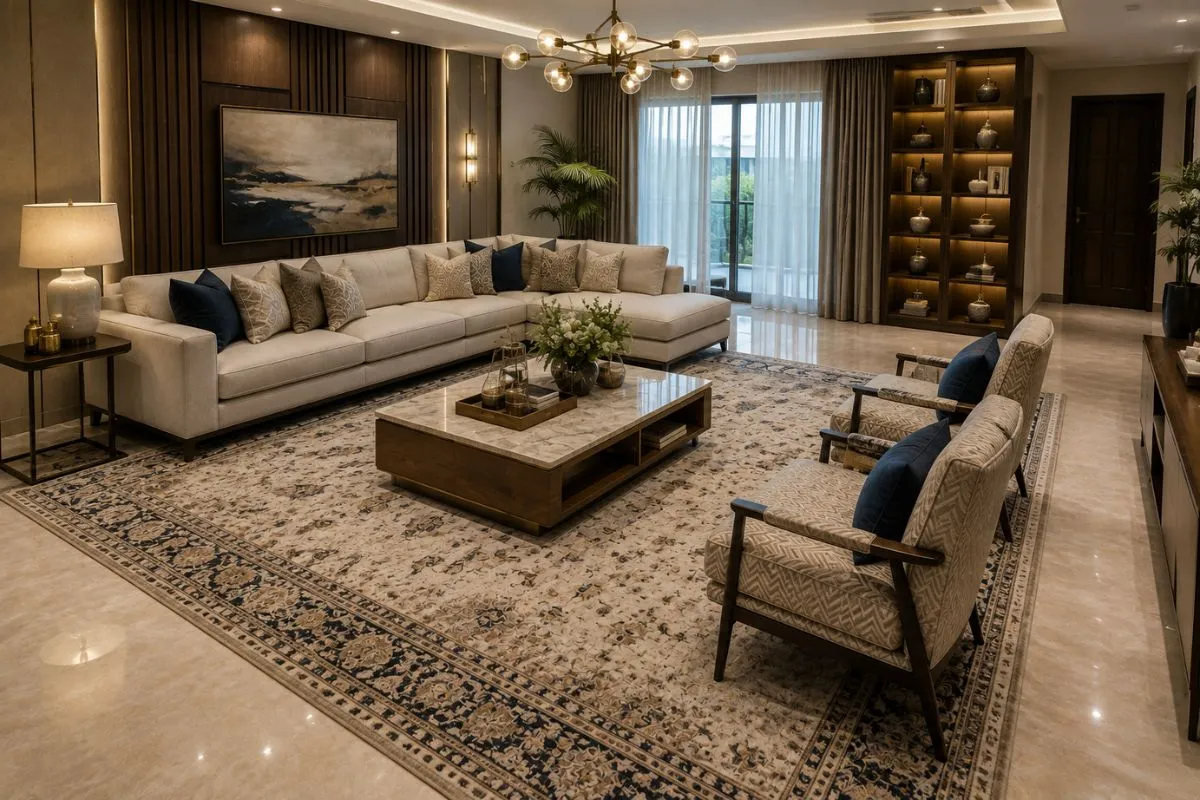
Think of the rug as the room’s quiet organiser. Pick the dimensions first, then position the sofa, chairs and coffee table in response to it. Following the Rug Size Rule Living Room approach helps create a balanced layout where every furniture piece feels connected. A large enough rug makes even simple furniture look more collected. It also lets you mix textures. Bouclé chairs, timber tables, brass lighting, and a clean lined sofa can sit together because the rug gives the composition one shared ground.
For a more layered look, place a refined hand-knotted or wool rug as the main piece and build the room around it. Avoid adding a smaller decorative rug on top unless the base is plain and the layered piece has a clear purpose. Layers should add texture, not visual noise.
Applied well, the rug size rule turns a collection of good furniture into one calm, intentional room.
FAQ’s
1. How Can You Create a Designer-level Living Room With One Rug?
A 6 x 9 ft or 8 x 10 ft rug usually works well, depending on the chairs and room width. Keep the sofa’s front legs on it.
2. How Far Should a Rug Extend Beyond a Sofa?
Aim for at least 15 to 20 cm on either side of the sofa. More extension creates a more generous luxury look.
3. Can a Rug Be Too Large for a Living Room?
Yes. Leave a visible flooring border around the rug and keep clear of door swings. A rug that nearly touches every wall can feel like fitted carpet.
4. Do I Need a Rug Pad Under a Living Room Rug?
Yes, especially on tile, marble or wooden floors. It prevents slipping, reduces wear and makes the rug feel more comfortable underfoot.